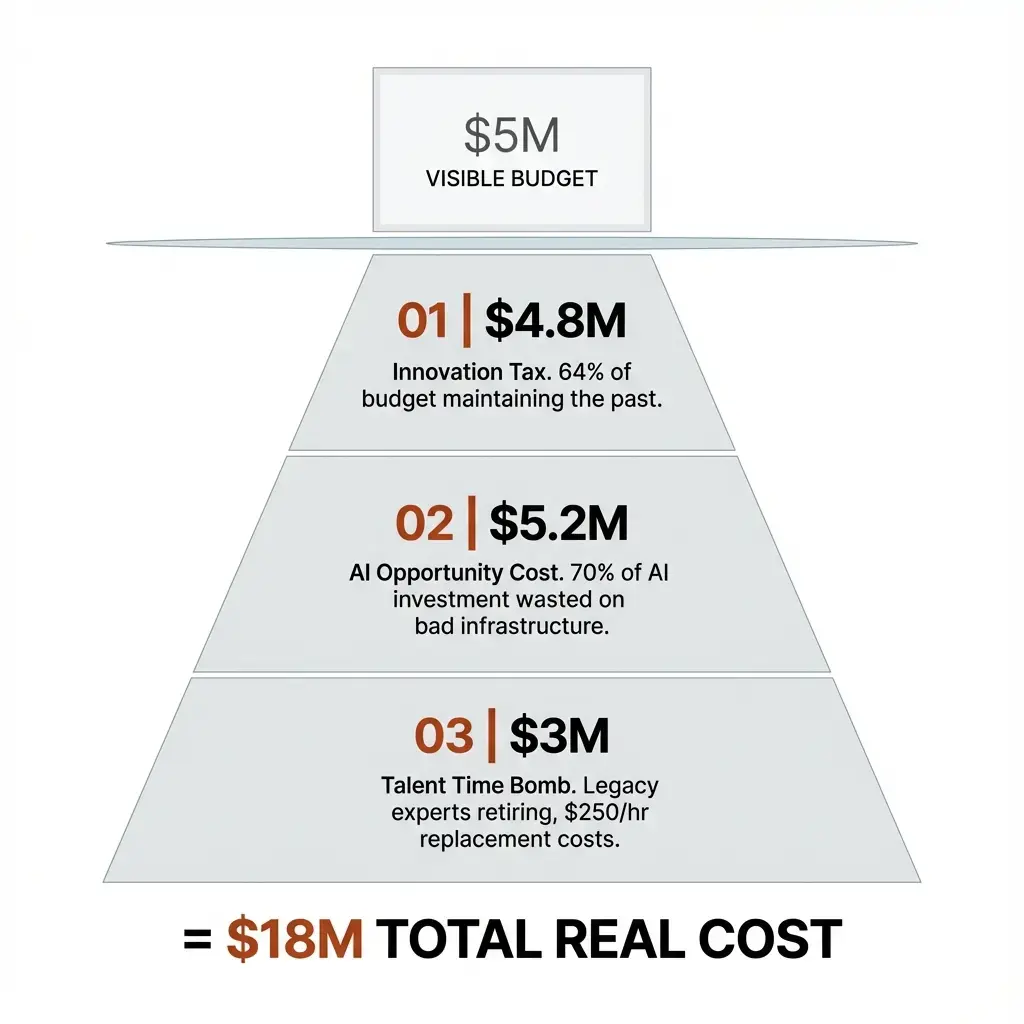
The visible number—let's say $5 million—looks manageable. Your CFO approves it. Your board nods along.
But across MDM implementations, ERP systems, and IoT infrastructure at dozens of organizations, the pattern is clear: that $5M is hiding a $13M problem.
The real cost isn't in your budget line items. It's in three places most finance teams never look.
The Innovation Tax: Paying to Stand Still
Your IT team isn't building the future. They're maintaining the past.
Research shows that financial institutions spend 64% of IT budgets just keeping legacy systems alive. The U.S. federal government? 80% of their $100+ billion IT budget goes to operations and maintenance.
McKinsey found that only 5-10 cents of every technology dollar actually generates new business value.
This dynamic plays out in real time. The best engineers spend their days patching 20-year-old systems instead of building what comes next. A 2024 SnapLogic survey found IT teams waste 5-25 hours weekly on legacy system patches, which equates to 13-65% productivity loss per engineer.
You're not investing in innovation. You're paying a tax to avoid it.
The math is brutal: while your competitors build AI capabilities and launch new products, your team is debugging COBOL and praying your mainframe doesn't crash during month-end close.
The AI Opportunity Cost: Missing the Future While Maintaining the Past
70% of AI investment gets wasted because companies didn't solve the infrastructure problem first.
Organizations routinely spend $10 million on AI initiatives and get $3 million in value. The other $7 million? Lost to data infrastructure that wasn't designed for AI workloads.
The problem isn't the AI. It's that you're trying to build the future on a foundation from 1995.
McKinsey reports that 70% of IT capacity in large enterprises goes to legacy maintenance instead of modernization. That creates a massive opportunity cost. While you're maintaining old systems, your competitors are implementing AI that actually works.
Legacy infrastructure integration increases AI project costs by 40-60%. 55% of financial institutions can't support real-time payments because their legacy systems won't allow it. That's $8 trillion in projected 2025 instant payment volume they're leaving on the table.
You're not just maintaining old systems. You're blocking access to new revenue.
The Talent Time Bomb: When Knowledge Walks Out the Door
Remember that expert who could create the board report from 17 different data sources? The one who took four days to build it every quarter?
She just retired. And nobody knows how she did it.
This scenario plays out every day across enterprises. The average age of MDM and ETL experts is 55, and 40% are retiring within five years. Over half of professionals with mainframe or legacy expertise have already retired.
The cost is staggering. Organizations now pay COBOL programmers $250/hour versus $90 for modern stack engineers. Some companies are paying $100-500 per hour for freelance legacy consultants just to keep systems running.
But the real damage isn't the hourly rate. It's the tribal knowledge that disappears.
When your data expert leaves, she takes 20 years of process knowledge with her. The new person doesn't know which systems to query, how to reconcile the discrepancies, or why that one calculation uses a different formula than everything else.
Developer surveys show 78% find excessive legacy maintenance hurts job satisfaction, contributing to 30% annual turnover in IT departments. Top talent increasingly refuses positions that require legacy system work.
You're not just losing people. You're losing the ability to operate.
Why Traditional Modernization Keeps Failing
The standard playbook is broken. Consultants sell you a rip-and-replace strategy. New licenses generate fees. Consulting hours stack up. Configuration takes months.
And 68% of modernization projects fail.
The economics are clear: vendors make money from new licenses and consulting hours. That's their business model. They're not incentivized to find faster, cheaper solutions.
Organizations underestimate true legacy system costs by 70-80%. One mid-sized European bank estimated €2M/year in core system costs. A comprehensive audit revealed true costs of €6.8M.
Technical debt now costs U.S. businesses $2.41 trillion annually.
The Alternative: Stop Replacing, Start Layering
Two decades of modernization projects point to the same conclusion: ripping out legacy systems isn't necessary to stop the bleeding.
What's needed is an AI-native layer that sits on top of existing infrastructure.
This approach ingests metadata, learns workflows, and provides conversational intelligence without system replacement. Implementation takes minutes instead of months. ROI shows up in 90 days.
When the MDM expert retires, the AI layer has already captured the process. The replacement doesn't start from zero—they inherit 20 years of institutional knowledge.
Hidden data becomes accessible. Dashboards get smarter. Business insights emerge: customer identity resolution, product information clarity, price elasticity analysis, cannibalization modeling.
You stop paying the innovation tax because you're no longer trapped in maintenance mode.
What Your CFO Should Be Asking
The next time you present your IT budget, your CFO should ask three questions:
1. What percentage of our IT budget goes to maintenance versus innovation?
If the answer is above 50%, you're paying the innovation tax.
2. How much are we spending on AI initiatives that can't deliver value because our data infrastructure isn't ready?
If you can't answer this, you're bleeding opportunity cost.
3. What happens when our legacy system experts retire in the next five years?
If the answer is "we'll figure it out," you're sitting on a talent time bomb.
The $13 million in hidden costs isn't coming from poor planning or bad decisions. It's coming from a broken playbook that treats modernization as an all-or-nothing replacement project.
You can keep following that playbook and watch your real costs balloon while your competitors move faster.
Or you can stop replacing and start layering.
The choice determines whether your $5M budget stays at $5M or quietly becomes $18M while your board wonders why innovation keeps getting delayed.