
AI Adoption
Infrastructure Costs

6 min read
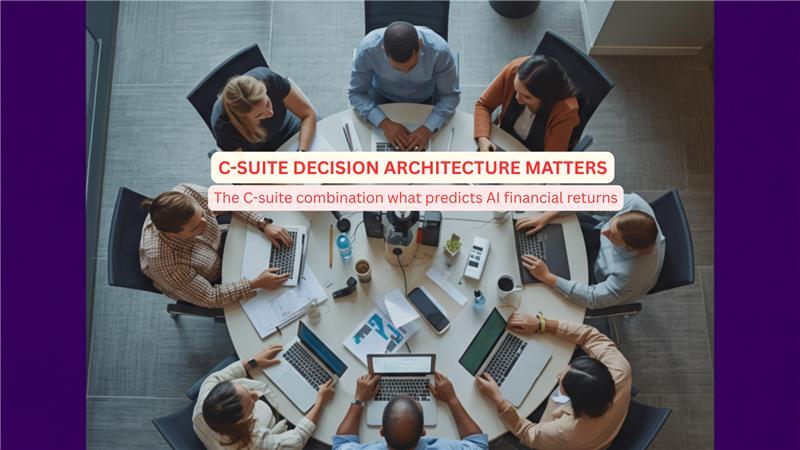
Deloitte's 2025 Tech Value Survey of 550 business and technology leaders ran predictive modeling against a comprehensive set of value indicators: ROI from technology investment, movement across 46 operational and financial KPIs, and reported EBITDA gains. The finding was specific. When the CTO, CFO, and Chief Strategy Officer jointly own AI investment decisions, organizations are far more likely to see above-average EBITDA, greater KPI progress, and advances in technology capabilities.
The C-Suite AI Alignment Problem: Why Your AI Investments Are Being Steered by the Wrong People
The most expensive question in enterprise AI right now is not "which tools should we buy?" It is "who should be making that decision?"
Most organizations have a default answer: the CTO or CIO. And most organizations are leaving significant financial value on the table as a result.
Deloitte's 2025 Tech Value Survey of 550 business and technology leaders ran predictive modeling against a comprehensive set of value indicators: ROI from technology investment, movement across 46 operational and financial KPIs, and reported EBITDA gains. The finding was specific. When the CTO, CFO, and Chief Strategy Officer jointly own AI investment decisions, organizations are far more likely to see above-average EBITDA, greater KPI progress, and advances in technology capabilities.
Not the CTO alone. Not the CIO alone. The combination.
Yet Deloitte's same research found that CIOs and CTOs still drive 60 to 80% of technology decisions at most enterprises. The executives whose perspectives are most predictive of financial success, the CFO and Chief Strategy Officer, are largely absent from the room where AI investment decisions are made.
What Each Executive Brings, and What Is Missing Without Them
The Deloitte research is not making a philosophical argument for inclusion. It is making a structural argument for outcomes.
Each executive in the CTO-CFO-CSO combination brings a fundamentally different value lens to AI investment decisions.
The CTO/CIO brings technical capability: understanding of what AI can do, what architecture enables scalability, and what infrastructure is required for the ambitions being set.
The CFO brings financial discipline, ensuring AI investments are tied to measurable cost and revenue outcomes rather than just technical delivery milestones. Deloitte's predictive modeling found that when CFOs have full decision-making authority over technology decisions, organizations are more than twice as likely to outperform on profitability compared to those where CFOs have no authority. Deloitte's Q4 2025 CFO Signals survey, which polled 200 CFOs at companies with at least $1 billion in revenue, found that 87% of CFOs say AI will be extremely or very important to their finance department in 2026. Yet most CFOs are still being asked to approve AI budgets rather than co-design AI strategy.
The Chief Strategy Officer brings competitive alignment, ensuring AI investments serve the company's actual strategic priorities rather than the technology roadmap's internal logic. Without this perspective, technically excellent AI programs routinely optimize for the wrong outcomes.
Deloitte's conclusion: no single role can drive strategic KPI alignment, technical capability growth, and profitability on its own. All three are required for the full set of value outcomes most organizations are seeking.
The Alignment Crisis Running in the Background
The ownership gap does not exist in isolation. It exists inside a broader alignment crisis that Adecco's 2025 research of 2,000 C-suite leaders across 13 countries documents in detail.
53% of CEOs say their leadership teams struggle to align priorities in a timely way. When asked to diagnose the specific blockers to AI progress, the C-suite gave fragmented answers that reveal the problem:
Each function sees the problem through its own lens. Nobody has a view of the whole. This is not a personality or culture problem. It is an architecture problem, specifically the absence of a shared intelligence layer that gives every C-suite leader a common picture of what AI is doing, what it costs, and what it is returning.
The Role That Is Rising, and Why It Changes Everything
Deloitte's 2026 CDAO Survey, conducted with 100 C-suite executives in August and September 2025, captures a related shift. 94% of CDAOs expect their influence to grow over the next 12 months. 78% say AI has led them to have more power as decision-makers. 65% say AI adoption has made their role more critical.
The CDAO, or Chief Data and Analytics Officer, is emerging as the connective tissue between the CTO's technical capability, the CFO's financial discipline, and the CSO's strategic alignment. Deloitte found that 78% of CDAOs describe their organizations as "actively implementing" data modernization, and 61% identify improving data quality and access as the key requirement for AI and agentic AI initiatives to succeed.
This matters because data modernization is precisely what enables the cross-functional AI alignment Deloitte's predictive modeling identifies as the source of above-average financial returns. When the data layer is unified, all three perspectives, technical, financial, and strategic, can finally look at the same picture.
The Tech C-Suite Reinvention
Deloitte's 2025 Tech Exec Survey of 622 senior technology leaders adds the organizational context: the tech C-suite itself is being restructured. Half of respondents report having four or more technology-related executives, including CIO, CTO, CDAO, and CISO, at their organization. This growth reflects the genuine complexity of managing AI across all business functions.
But complexity without coordination produces the same fragmentation at the leadership level that siloed AI tools produce at the operational level. About 26% of tech leaders say it is difficult to maintain clear role distinctions in this expanded C-suite.
Deloitte's Ranjit Bawa, U.S. Chief Strategy and Technology Officer, captures the imperative directly: "Where the C-suite leads the shift, more value can be realized. When adoption is fragmented, progress is slowed."
The three actions Deloitte identifies as critical to succeeding in this environment are engaging frontline and mid-level staff, co-creating technology strategy with peers, and effectively articulating technology's value in business terms. All three require the kind of cross-functional alignment most enterprises have not yet built.
What a New AI Decision Model Looks Like
Changing who is in the room for AI investment decisions is necessary but not sufficient. The deeper change is building the infrastructure that gives every C-suite participant, technical, financial, and strategic, a shared intelligence foundation from which to contribute meaningfully.
A CIO or CTO who presents AI investment options to a CFO and CSO with no visibility into what the existing AI portfolio is doing, what outcomes it is producing, or where the data gaps are, cannot generate the informed joint ownership that Deloitte's research identifies as the predictor of above-average EBITDA.
The organizational design implications are clear.
1. Expand ownership formally. Establish a standing AI investment committee with CTO/CIO, CFO, and CSO representation, not as a review body for decisions already made, but as the originating group for AI strategy.
2. Elevate the CDAO. Deloitte's data is clear: the CDAO role is becoming the enabling layer for cross-functional AI alignment. Organizations that have not yet created this role, or have created it without the authority to drive data modernization across functions, are missing the connective tissue.
3. Define value metrics that every C-suite member can own. The challenge Deloitte identifies, that CFOs, CIOs, and CTOs define success differently across ROI, EBITDA, and KPIs, is solvable only if a shared measurement framework exists. AI investments should be evaluated against outcomes every executive can see in real time.
4. Build shared intelligence infrastructure. The fastest path from fragmented AI ownership to unified AI value is a single intelligence layer that connects what every function's AI systems are producing into a coherent picture for leadership. This is what transforms AI from a collection of departmental tools into a strategic asset with a shared owner: the entire C-suite.
The Financial Cost of Leaving This Unchanged
Deloitte's research identified a clear pattern: AI is consuming digital budgets at a significant rate, pulling from legacy modernization, security, and other technology investments, without producing proportional financial outcomes in most enterprises. The reason, as Deloitte's analysis concludes, is misalignment at the leadership level: "CFOs, CIOs, and CTOs are often pulling in different directions, possibly leaving enterprise value stranded in the gaps."
That stranded value is not recoverable by deploying more AI tools. It is recoverable by changing who steers the ones already deployed and by giving those leaders the shared intelligence infrastructure to steer together.
Aevah's Executive Partnership AI creates a 24/7 strategic intelligence layer that learns your organization's priorities and amplifies the effectiveness of every C-suite leader, giving technical, financial, and strategic perspectives a unified foundation for AI decision-making.
If your AI investment committee does not yet include your CFO and Chief Strategy Officer as co-owners, let's talk about what that change makes possible.